At AMP Fire Protection, we carry out many fire risk assessments (FRAs) across the UK each year — and increasingly, we are seeing a worrying pattern in schools, nurseries, academies, and childcare settings.
More and more, we are being called into environments where the organisation believed they were compliant… …but in reality, their fire safety measures were dangerously inadequate.
And the most concerning part?
These establishments had recently passed Ofsted inspections.
The Growing Problem: “We Have an FRA… So We’re Fine.”
Just this week, we were contacted by an academy trust responsible for several schools. They had discovered — only after internal review — that their fire risk assessment was not adequate or up to date. This wasn’t the first time we’ve seen this happen, and sadly, it’s becoming the norm.
Across many sites we attend, we encounter FRAs that were:
Completed by non-competent persons
Written by staff members or site managers without proper training
Missing key actions or containing outdated information
Carried out using generic templates that don’t reflect the building’s actual risks
One creche and café venue we attended had:
No fire alarm system
No fire extinguishers
No emergency lighting
A fire exit that was seized shut
And yet — they had passed their Ofsted inspection.
The manager genuinely believed fire safety was the landlord’s responsibility. Ofsted had seen a “fire risk assessment” on site, ticked the box, and moved on.
Where the System Breaks Down: Ofsted Are Not Fire Safety Professionals
This is the central issue.
Ofsted inspectors are not trained fire safety specialists.
Their inspection handbook requires them only to check the presence of a fire risk assessment — not to determine whether:
It was completed by a competent fire risk assessor
It is suitable and sufficient
The actions have been completed
The premises meet the Regulatory Reform (Fire Safety) Order 2005
This means a setting can present any document labelled “Fire Risk Assessment”, and it will be accepted as evidence of compliance.
In reality, this creates a dangerous loophole.
Children, staff, and visitors may be placed at significant risk — not because the setting doesn’t care about safety, but because they assume passing Ofsted equals being compliant. It does not.
Why Schools and Childcare Settings Are Particularly Vulnerable
From our experience at AMP Fire, schools, nurseries, academies, and childcare venues face unique risks:
Frequent staff turnover
Misunderstanding around landlord vs tenant responsibilities
Buildings with aging infrastructure
Rapid repurposing of rooms and spaces
High occupant vulnerability (children, infants, SEND pupils)
Limited budgets and reliance on internal staff “doing their best”
These environments need robust, professional, and regularly reviewed fire safety planning — far beyond what a basic template FRA or a quick inspection can provide.
“Competent Person” Requirements — A Legal Obligation, Not a Suggestion
The law is clear.
Under the Regulatory Reform (Fire Safety) Order 2005, a fire risk assessment must be completed by a competent person — someone with:
Sufficient training
Knowledge
Skills
Experience
Understanding of fire safety legislation
A member of staff with no fire safety background does not meet this requirement, even with the best intentions.
A tick from Ofsted does not override UK fire safety law.
The Consequences of Inadequate Fire Safety
Beyond the obvious risk to life, the repercussions for schools and childcare providers can include:
Enforcement notices from fire authorities
Insurance refusal in the event of a fire
Legal liability for senior leaders
Reputational damage
Closure of premises
These are outcomes we help clients avoid every day — but awareness is critical.
How AMP Fire Helps Schools & Childcare Providers Get Back on Track
At AMP Fire, we specialise in supporting educational and childcare settings with:
Competent, accredited fire risk assessments
Clear, prioritised action plans
Fire alarm, extinguisher, and emergency lighting installation & servicing
Compliance advice for academy trusts and multi-site organisations
Training for staff and Responsible Persons
Our goal is simple: To ensure no school or childcare provider is left believing they are compliant when they are not.
If Your Setting Has Passed Ofsted — But You’re Still Unsure
You are not alone.
We encourage any school, nursery, or childcare provider to ask:
Was our FRA completed by a competent assessor?
Is it up to date?
Have the actions been completed?
Would it stand up to scrutiny from the Fire and Rescue Service?
If the answer to any of these is “no” or “I’m not sure”, we can help.
🔥 Get a Professional Fire Risk Assessment from AMP Fire
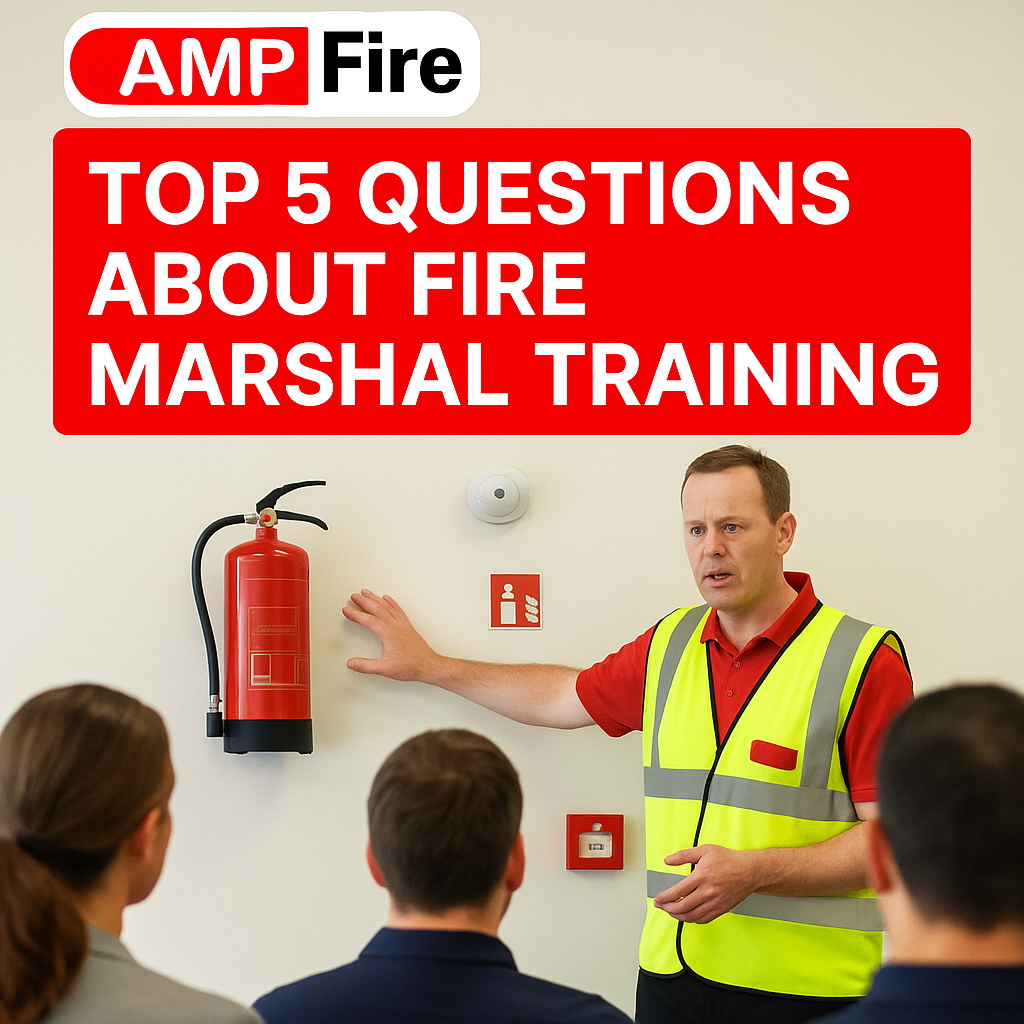
Top 5 Most Commonly Asked Questions About Fire Marshal Training
Fire marshal training is essential for ensuring that your workplace is prepared to respond quickly, safely, and confidently in the event of a fire. At AMP Fire, our fire safety training is delivered by real firefighting professionals who combine hands-on experience with clear, practical instruction.
Below, we break down the five most common questions businesses ask about fire marshal training — and the answers your organisation needs to stay compliant and protected.
1. What exactly does a Fire Marshal do?
One of the most frequent questions companies ask is “What are a fire marshal’s actual responsibilities?”
A Fire Marshal (or Fire Warden) plays a crucial role in preventing fires, supporting evacuation, and helping maintain fire safety standards in the workplace.
Their responsibilities typically include:
Coordinating and assisting evacuation during an emergency
Checking escape routes and fire exits
Reporting fire safety issues to management
Assisting in roll calls at the assembly point
Performing routine fire safety checks
Understanding the site’s fire alarm system and zones
During AMP Fire’s training, we break these duties down clearly, ensuring each participant fully understands their role and what’s expected of them — both day-to-day and in an emergency.
2. How often should Fire Marshal training be completed?
Most businesses want to know the recommended frequency for training. While the law does not specify an exact interval, UK fire regulations require employers to ensure marshals remain competent, meaning training must be refreshed whenever:
Procedures or staff change
The building layout changes
Systems or equipment are updated
Marshals feel they need a refresher
In practice, most companies schedule refresher training every 1–2 years.
AMP Fire offers flexible on-site training packages, making it easy for teams to maintain competency without disrupting operations.
3. Do Fire Marshals need hands-on extinguisher training?
A very common question — and the answer is yes, absolutely, if it’s safe and practical to do so.
Many employees have never used an extinguisher before, and learning during an emergency is not an option.
AMP Fire’s courses include supervised, practical extinguisher training, giving delegates the confidence to:
Recognise different extinguisher types
Understand which extinguisher is suitable for which fire
Use an extinguisher safely and effectively
Know when not to attempt to fight a fire
This practical element is what many attendees say is the most valuable part of the course.
4. How long does Fire Marshal training take?
Businesses often assume that fire safety training takes a whole day — but that’s not the case.
AMP Fire’s Fire Marshal training is typically delivered in a compact, informative session (usually under 3 hours), covering both theory and practical elements.
This makes it ideal for:
Busy workplaces
Shift-based staff
Multiple groups throughout the day
Mixed role teams
Despite the short duration, our training is comprehensive, engaging, and tailored to your building and procedures.
5. How many Fire Marshals does our workplace need?
The answer varies, and that’s why it’s such a common question.
There is no fixed number, but the correct amount depends on:
Building size and layout
Number of employees
Whether you operate shifts
Specific risks (kitchens, workshops, storage, public access, etc.)
Staff absences, holidays, or remote working
A general rule is that you need enough marshals to ensure coverage at all times, including sickness, breaks, and annual leave.
During training, AMP Fire trainers help businesses assess if their staffing level is appropriate and compliant.
Why Choose AMP Fire for Fire Marshal Training?
AMP Fire’s training stands out by offering:
Professional instructors with real firefighting backgrounds
Combined theory + live extinguisher practical sessions
Certificates for all attendees
On-site training across the UK
Sessions for up to 12 people starting from just £299.99
Guidance tailored specifically to your building, risks, and procedures
Whether you need new Fire Marshals trained or existing staff refreshed, AMP Fire delivers clear, confident instruction that meets UK fire safety requirements.
Book Fire Marshal Training With AMP Fire
Equip your team with the knowledge and skills they need to protect your workplace.
Fire safety is a legal and moral responsibility for every business in the UK. From small retail units to large commercial premises, having a reliable and professionally installed fire alarm system is essential for complying with UK fire regulations and protecting lives. At AMP Fire, we specialise in delivering high-quality fire alarm installations, maintenance, and ongoing support tailored to your building’s specific risks.
In this guide, we explain why investing in a professionally installed fire alarm system is crucial, what UK businesses must legally comply with, and how AMP Fire ensures maximum protection for your premises.
Why Fire Alarm Systems Are Essential for UK Businesses
A fire can break out at any time—often without warning. A properly designed and installed fire alarm system ensures:
✔ Early detection
Minimising damage, reducing downtime, and giving building occupants valuable time to evacuate.
✔ Compliance with UK fire safety laws
Under the Regulatory Reform (Fire Safety) Order 2005, all non-domestic properties must have “appropriate fire detection and alarm systems” based on a fire risk assessment.
✔ Reduced insurance premiums
Many insurers require a certified fire alarm installation to provide full coverage.
✔ Peace of mind
Knowing your building meets the highest safety standards allows you to focus on running your business.
Types of Fire Alarm Systems AMP Fire Installs
Every building is different, which is why we provide tailored solutions to meet specific fire risks and property layouts. AMP Fire offers installation of:
🚨 Conventional Fire Alarms
Ideal for small or low-risk premises. Cost-effective and reliable.
🚨 Addressable Fire Alarms
Best suited for larger buildings. Each device has a unique address, making it easy to identify the exact location of a fire.
🚨 Wireless Fire Alarm Systems
Perfect for heritage buildings, temporary sites, or places where cabling is difficult.
🚨 Aspirating Smoke Detection (ASD) Systems
Highly sensitive systems for environments where early detection is critical—such as data centres or high-value storage areas.
UK Fire Alarm Regulations: What Businesses Must Know
To stay compliant, your fire alarm system must meet the relevant British Standards:
📌 BS 5839-1
The standard for fire alarm systems in non-domestic properties.
📌 Fire Risk Assessment Requirement
Every business must carry out a fire risk assessment and update it regularly.
📌 Routine Testing and Maintenance
Weekly tests and annual servicing are required to ensure continued compliance.
AMP Fire not only installs systems according to the latest standards—we also provide full maintenance and testing packages to keep you compliant year-round.
Why Choose AMP Fire for Fire Alarm Installations?
✔ Qualified & experienced engineers
Our team is trained to the highest standards, ensuring every installation meets UK fire safety regulations.
✔ Tailored system design
We assess your building, identify potential fire risks, and design a system that offers the best protection.
✔ Full installation, commissioning & certification
We handle everything from planning to installation, testing, handover, and certification.
✔ Ongoing maintenance & support
Our team provides routine inspections, monitoring, and rapid response to keep your system fully operational.
✔ Local & national coverage
Based in the UK, AMP Fire supports businesses across the country with reliable, professional fire protection services.
Industries We Serve
AMP Fire works with a wide range of industries, including:
Retail & hospitality
Offices & commercial buildings
Warehouses & industrial sites
Schools & educational facilities
Care homes & healthcare settings
Construction & temporary sites
No matter the size or complexity of your building, we offer dependable fire alarm services to keep staff, visitors, and assets safe.
The AMP Fire Installation Process
We make fire protection simple and stress-free:
Initial consultation & site survey
Fire risk assessment review
System design & planning
Professional installation
Testing, commissioning & certification
Ongoing maintenance & support
Get a Free Fire Alarm Installation Quote
If you’re looking for a trusted provider of fire alarm installations in the UK, AMP Fire is here to help. We combine industry expertise, high-quality equipment, and outstanding customer service to give you complete peace of mind.
📞 Contact AMP Fire today for a free consultation or quote. 🌐 Visit: ampfire.co.uk
Your Free Logbook Is Here – Make Routine Checks Effortless!
Hi there,
We hope you’re doing well. Over the years, we’ve noticed a couple of recurring issues that come up with many of our customers—and they’re both completely understandable.
First, a lot of people simply don’t realise they need to complete their logbook. Second, even when they do know, they’re often unsure what their routine checks are supposed to include. And honestly, that’s not your fault. Clear, simple information isn’t always easy to find.
That’s why we’ve created something to make your life much easier.
📘 Your Free PDF Logbook (Click to Download below)
We’ve put together a Free PDF Logbook designed to remove all the confusion and give you everything you need in one place. Inside, you’ll find:
✔️ A full, easy-to-use logbook layout
✔️ Clear explanations of routine checks
✔️ What needs completing and when
✔️ Space to record and track your maintenance
✔️ A simple format built for everyday use
Whether you’re new to the process or you just want a cleaner, more organised way to stay compliant, this logbook was made to help you stay on top of everything with confidence.
Why Keeping a Logbook Matters
Your logbook isn’t just a formality—it’s an essential part of proving your equipment has been properly checked and maintained. A completed logbook helps:
Prevent avoidable breakdowns
Keep you compliant
Protect warranties
Provide a clear service history
Save time and stress when issues arise
And now, with the included PDF, staying up to date is easier than ever.
Need Help or Have Questions?
If you’re unsure about anything, from routine checks to using the logbook, we’re always here to help. Just hit reply and we’ll be happy to guide you.



 AMP Fire
